
How to Buy Off-Grid Land in Arizona: A Due Diligence Checklist for Buyers
Explore Arizona Land Off-Grid
Looking for Available Acreage in Arizona?
Browse our current selection of off-grid land parcels or get in touch with our team directly to discuss what you're looking for.
Buying vacant land isn't like buying a home. There's no listing agent walking you through a finished kitchen, no inspection report on the counter, no appraisal comping out a move-in-ready structure. When you're evaluating off-grid land for sale in Arizona, the "property" is often little more than a legal description, a set of GPS coordinates, and a whole lot of sky — which is exactly the appeal for the right buyer.
It's also why due diligence matters more here than in almost any other real estate transaction. At AZ Land Off Grid, we've closed deals with dozens of buyers chasing the same goal: a quiet, unimproved parcel in Arizona's high desert, priced right and free of surprises. The buyers who ran their due diligence before closing walked away happy. The few who skipped steps sometimes found themselves upside down — saddled with landlocked acreage or a parcel they couldn't legally build on. Below is what belongs on your due diligence checklist before you make an offer.
Why Buyers Are Drawn to Off-Grid Land in Northern Arizona
Northern Arizona attracts buyers looking for acreage over square footage — space, privacy, dark skies, and the ability to build on their own timeline rather than a subdivision's. Some are underwriting a future homestead. Others want raw land as a long-term hold or a basecamp for recreational use.
Whatever the exit strategy, the math is favorable: forty acres in Coconino or Yavapai County can list for less than a new car, especially compared to coastal markets. But price per acre only tells part of the story. A parcel with title defects, no legal access, or restrictive zoning isn't actually a discount — it's a deferred cost. That's the gap due diligence is meant to close before you're under contract.
Access Rights Come Before the View
The view sells the parcel; the access rights determine whether you can use it. Before submitting an offer on any Arizona land for sale, verify:
- Recorded access. Does the parcel have a recorded easement or public road frontage, or would reaching it require crossing someone else's private land without a documented right-of-way?
- Maintenance responsibility. Is the road maintained by the county or a road maintenance association, or is it an unmaintained two-track subject to washouts?
- Year-round drivability. Can a standard vehicle reach the parcel in all seasons, or is four-wheel drive required after rain or snow?
A parcel without legal, recorded access is a title issue as much as a practical one — you can hold clear title to land you're not legally entitled to reach. This should be confirmed with a title company or the county recorder before you go under contract, not after.
Zoning and Entitlements: Confirm Before You Contract
Rural Arizona counties offer more flexibility than incorporated cities, but "unincorporated" doesn't mean unregulated. Every parcel still falls under county zoning and building code, and your intended use needs to match what's entitled.
Before writing an offer, confirm directly with the county planning department:
- Permitted structure types — site-built home, manufactured home, RV, tiny home
- Minimum square footage requirements for a permanent dwelling
- Septic and wastewater permitting requirements
- Setback requirements from property lines and recorded easements
Buyers frequently assume off-grid land carries no entitlement restrictions. In practice, the zoning is simply different from a subdivision's — not absent.
Utilities and Infrastructure: Underwriting Off-Grid Systems
Off-grid living isn't utility-free — it shifts water, power, and waste from municipal services to owner-installed infrastructure. Underwrite these three line items like you would any capital improvement:
- Water. Some parcels sit above water tables too deep for cost-effective well drilling. Hauling water is a common, low-cost alternative in Northern Arizona, often running just a few cents per gallon. Other buyers target parcels near community wells, which may carry annual access fees — factor those into your holding costs.
- Power. Solar is the standard off-grid power solution, typically paired with battery storage and a backup generator. Wind is viable on some parcels depending on elevation and exposure. This is established, bankable technology — not a speculative build.
- Wastewater. Alternative septic systems are standard for off-grid parcels but still require county approval, which ties directly back to the zoning confirmation above. Treat these as one due diligence step, not two.
Verify the Legal Description: Boundaries, Pins, and Easements
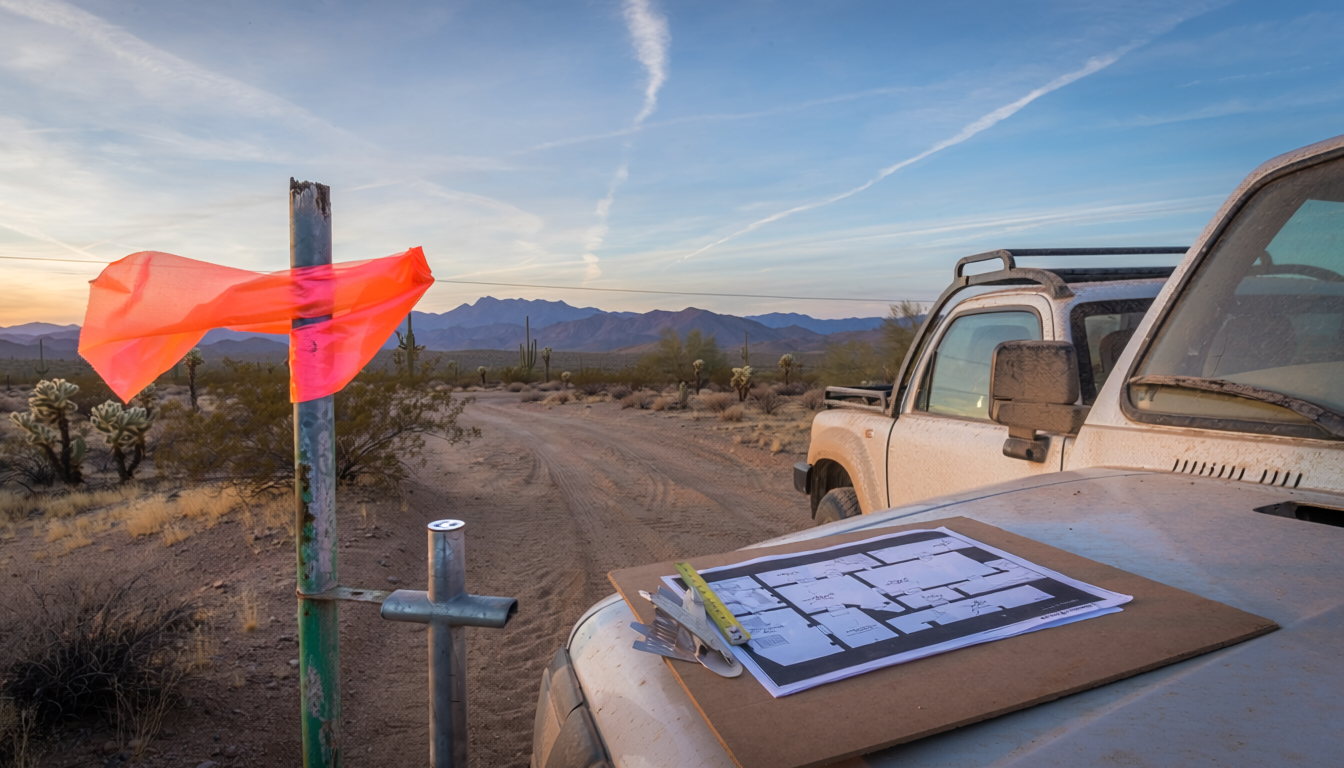
Raw land rarely comes fenced to its legal boundaries. Survey monuments (pins) mark the corners, but they can be buried, disturbed, or difficult to locate without professional equipment. Before closing, confirm:
- The location of survey pins or corner monuments
- Any recorded easements — utility, access, or otherwise — that encumber the parcel
- Whether adjoining parcels share a recorded access or maintenance agreement
A licensed surveyor or local land specialist can confirm all three in a single site visit, and it's cheap insurance against a boundary dispute down the road.
Financing an Off-Grid Purchase
Conventional mortgage products rarely apply to raw, unimproved acreage — most lenders won't underwrite it. That's where seller (owner) financing fills the gap. AZ Land Off Grid and many sellers in this market offer owner-financed terms with manageable down payments and flexible credit requirements, opening the door to buyers who wouldn't qualify for a traditional land loan.
Cash offers typically move faster and may come with pricing leverage, since there's no underwriting timeline to accommodate. Neither structure is inherently better — it comes down to your liquidity and how quickly you want to close.
Pre-Offer Due Diligence Checklist
Run through this list before you finalize any purchase of off-grid land in Arizona:
- Confirm recorded, legal road access and year-round drivability
- Verify zoning permits your intended structure type
- Assess water hauling distance or well feasibility
- Evaluate solar exposure and power infrastructure options
- Locate survey pins and confirm legal boundaries
- Confirm property tax obligations and any HOA/road association fees
- Review and understand your financing terms in full before signing
None of these steps require more than a phone call or a short site visit — and together, they're the difference between a clean closing and a costly surprise.
The Bottom Line
Raw land is one of the more forgiving asset classes to buy right — and one of the least forgiving to buy wrong. Every question you ask before closing is one less liability after. At AZ Land Off Grid, we walk every buyer through this exact due diligence process — road access, zoning, utilities, and financing — so purchasing off-grid land in Arizona feels like a straightforward transaction, not a gamble.
Browse our current inventory of off-grid parcels at azlandoffgrid.com, or reach out directly — we're happy to walk through the due diligence on any listing you're considering.
Frequently Asked Questions
Is it legal to live off-grid in Arizona? Yes. Most rural counties permit off-grid living, though local zoning still governs which structures are allowed and what utility setups meet code.
How much does off-grid land in Arizona typically cost? Pricing varies by acreage, location, and existing improvements — from a few thousand dollars for smaller lots to several hundred thousand for larger, improved parcels.
Do I need a well to live off-grid on Arizona land? Not necessarily. Many owners haul water affordably instead, particularly in areas where the water table is too deep for cost-effective drilling.
What's the first due diligence step when buying off-grid property in Arizona? Confirm recorded legal access and zoning before making an offer. Both directly affect what you can build and how reliably you can reach the parcel. AZ Land Off Grid helps verify both before any buyer signs.